mohameddosou
News • Books • Investing & Finance
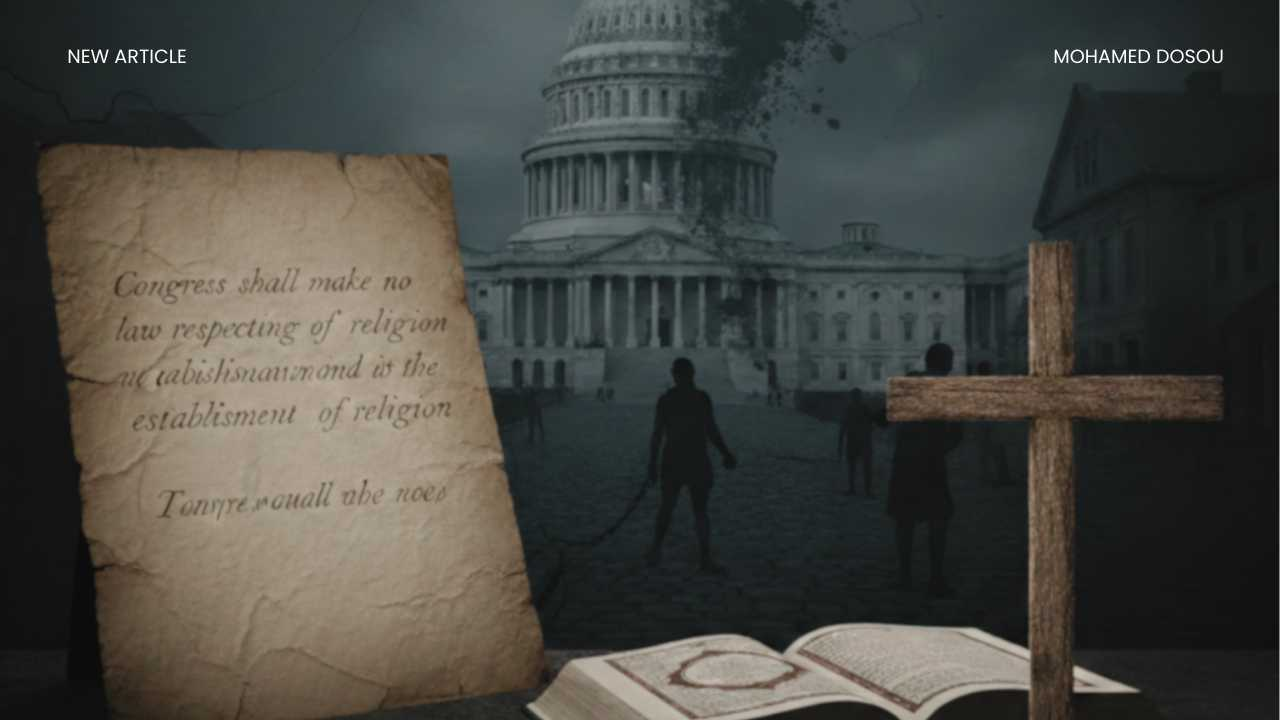
America Was Never a "Christian Nation"
Islam, Slavery, and the Forgotten Truth of the American Founding
January 31, 2026
post photo preview

PART I

Founding Myth vs. Historical Reality

How the Story of a “Christian Nation” Was Manufactured - and Why It Refuses to Die

When Myths Become Political Weapons

Every nation tells stories about its birth. Some are honest. Most are convenient. A few are so carefully repeated that they harden into sacred truths, immune to evidence and resistant to doubt.

In the United States, one such story has grown louder in recent years: the claim that America was founded as a Christian nation - not merely influenced by Christianity, but ordained by it; not shaped by pluralism, but anchored in a single religious identity. This claim is no longer whispered on the fringes. It is declared confidently by senators, preachers, media figures, and political movements that frame dissent not as disagreement, but as betrayal.

Yet history, when examined without fear or nostalgia, tells a far more complex - and far more unsettling - story.

This essay begins where myths usually collapse: not in ideology, but in evidence. Not in sermons, but in documents. Not in modern culture wars, but in the intellectual and moral anxieties of the eighteenth century.

What follows is not an attack on Christianity. Nor is it an elevation of Islam, secularism, or any competing worldview. It is something far more dangerous to power than polemic: a historical reckoning.

Because when nations lie about their origins, they inevitably lie about their obligations.

The Seductive Simplicity of the “Christian Nation” Claim

The appeal of the “Christian nation” narrative lies in its emotional economy. It offers certainty in a time of confusion. It promises moral clarity in an era of pluralism. And most importantly, it transforms political power into divine inheritance.

If the nation is Christian by design, then political authority becomes theological stewardship. Laws become sacraments. Borders become holy. Dissent becomes heresy.

This is not accidental. It is strategic.

The claim rests on three assumptions:

  1. That the Founding Fathers were devout, orthodox Christians.
  2. That American law was derived primarily from Christian theology.
  3. That religious homogeneity - not diversity - was the intended foundation of the republic.

Each assumption collapses under historical scrutiny.

The Founders Were Not What Modern Christian Nationalism Needs Them to Be

The Founding Fathers were many things: revolutionaries, slaveholders, philosophers, hypocrites, idealists, pragmatists. What they were not was a unified religious bloc.

Their spiritual landscape was fragmented, restless, and often openly skeptical.

Thomas Jefferson rejected the divinity of Jesus.
 James Madison feared religion fused with power more than he feared foreign invasion.
 John Adams viewed organized Christianity as historically corrupting.
 Benjamin Franklin believed in God but distrusted dogma.
 George Washington rarely referenced Christ and avoided sectarian language entirely.

This was not coincidence. It was intentional restraint.

The founders lived in the long shadow of Europe’s religious wars - centuries of bloodshed fueled by the certainty that God had chosen sides. They had watched churches crown kings, justify massacres, and sanctify tyranny. To them, the danger was not atheism. It was religious certainty wedded to state power.

That fear shaped the republic.

The Enlightenment, Not the Pulpit, Was the Foundational Classroom

The intellectual DNA of the United States was forged less in churches than in books banned by churches.

John Locke’s arguments for natural rights.
 Montesquieu’s separation of powers.
 Spinoza’s radical critique of religious authority.
 Voltaire’s relentless assault on clerical tyranny.

These were not Christian theologians. They were Enlightenment philosophers - many of whom were condemned, censored, or excommunicated by religious institutions.

The founders did not reject religion. They rejected religious domination.

The Declaration of Independence speaks of a “Creator,” not Christ.
 The Constitution mentions no God at all.
 The First Amendment explicitly prohibits religious establishment.

This was unprecedented. Not reform. Not moderation. Prohibition.

No European Christian nation had ever done this.

Thomas Jefferson’s Qur’an and the Anxiety of Pluralism

Few historical details unsettle Christian nationalist mythology more than Thomas Jefferson’s Qur’an.

Jefferson did not own it as a novelty. He studied it as a legal and philosophical text while training as a lawyer. He approached Islam not as an enemy faith, but as a civilization with moral and juridical traditions worth understanding.

More unsettling still: Jefferson explicitly envisioned Muslims as future American citizens.

In debates surrounding religious liberty, Jefferson and Madison argued that protections must extend not only to Christians, but to “the Jew and the Gentile, the Christian and the Mahometan.”

This was not symbolic tolerance. It was constitutional intention.

Religious freedom, to the founders, was meaningless if it applied only to the majority.

The Virginia Statute for Religious Freedom - America’s True Baptism

If the United States has a sacred text, it is not the Bible. It is the Virginia Statute for Religious Freedom.

Authored by Jefferson in 1777 and championed by Madison, the statute declared:

  • That no person should be compelled to support any religious worship.
  • That civil rights are independent of religious belief.
  • That religious opinion should never determine citizenship or political participation.

This was revolutionary.

Jefferson considered this achievement - alongside the Declaration - worthy of inscription on his tombstone. Not his presidency. Not his power. His defense of religious freedom.

Christian nationalists rarely mention this.

The Capitol’s Silent Rebuttal

Walk through the U.S. Capitol and you will find an inconvenient truth carved into stone.

Among the lawgivers depicted in the chamber that honors the foundations of Western legal tradition is a Muslim jurist. His presence is not decorative. It is declarative.

It acknowledges that American law did not emerge from a single religious stream, but from a confluence of traditions: Roman law, English common law, Enlightenment philosophy, and yes - Islamic jurisprudence.

This inclusion was deliberate. It reflected an understanding that civilization is cumulative, not exclusive.

The myth of a purely Christian legal lineage cannot survive this reality.

Islam Was Not Foreign to Early America - It Was Enslaved Within It

Perhaps the most uncomfortable truth for Christian nationalist narratives is this: Muslims were present at the founding of the United States - not as visitors, but as captives.

Historical research suggests that a significant portion of enslaved Africans brought to the Americas were Muslims. They carried Qur’anic literacy, legal traditions, and spiritual discipline into a land that denied their humanity.

Some wrote in Arabic.
Some fasted.
Some prayed in secret.
Some taught their children fragments of faith under threat of punishment.

They were not peripheral to American history. They were foundational to its economy.

And they were systematically erased.

Slavery and the Selective Memory of Christian Morality

Christian nationalism often frames Christianity as the moral engine of abolition. This is only half true.

Yes, religious movements fueled abolitionist fervor. But churches also defended slavery with biblical arguments for centuries. Scripture was wielded both to liberate and to enslave.

The founders themselves were divided:

  • Some denounced slavery as incompatible with liberty.
  • Others rationalized it as economic necessity.
  • Many owned human beings while preaching freedom.

This contradiction did not emerge from secularism. It emerged from selective theology.

The lesson is not that religion is evil. It is that religion, when fused with power, becomes malleable - and often cruel.

Why the Founding Myth Matters Now

Historical myths are not academic errors. They are political tools.

If America was founded as a Christian nation:

  • Religious minorities become guests, not stakeholders.
  • Secular law becomes suspect.
  • Pluralism becomes deviation.
  • Power becomes moralized.

This is why the myth resurfaces during periods of demographic change, cultural anxiety, and declining institutional trust.

The past is being rewritten to control the future.

The Danger of Retrofitting Destiny

The founders did not imagine America as finished. They imagined it as fragile.

They designed a system meant to resist certainty - especially religious certainty.

Christian nationalism does the opposite. It retrofits divine destiny onto historical ambiguity. It replaces debate with revelation. It transforms compromise into sin.

This is not faith. It is idolatry of nation.

History as Resistance

To tell the truth about America’s founding is not to diminish it. It is to honor its most radical aspiration: that people of radically different beliefs could govern themselves without sanctifying power.

That aspiration is unfinished.
And fragile.
And worth defending.

Part II will continue this investigation by confronting what American mythology most aggressively suppresses: the role of Islam, slavery, and non-Christian legal traditions in shaping the nation’s moral and constitutional foundations - and why acknowledging them threatens modern political theology.

PART II

Islam, Slavery, Law, and the American Birth

The Presence America Forgot - and the Truth It Was Never Meant to Remember

The Silence That Built the Republic

Nations do not only forget by accident. They forget by design.

Some silences are louder than any proclamation. They are maintained not through censorship, but through repetition - by telling one story so often that all others disappear beneath it. In the American imagination, Islam is framed as foreign, recent, incompatible. Muslims are portrayed as newcomers to a civilizational house already built.

History says otherwise.

Islam was present at the creation of the United States - not as an invading force, not as an external influence, but as a silenced presence inside its earliest economic engine: slavery. The contradiction is devastating. A nation born proclaiming liberty was simultaneously sustained by millions whose freedom was stolen - and among them were Muslims whose faith, literacy, and law were systematically erased to preserve a simpler national myth.

To understand America’s origins honestly, one must descend into that erasure.

Islam Enters America in Chains

The dominant American narrative imagines the first Muslims arriving in the late twentieth century - immigrants, refugees, students, strangers. But Islam’s entry into America predates the Constitution by centuries.

Historians estimate that between 10% and 30% of enslaved Africans brought to the Americas were Muslim. These were not marginal figures. Many came from regions such as Senegambia, Futa Toro, Mali, and parts of West Africa where Islamic scholarship, jurisprudence, and literacy had existed for centuries.

These were not “primitive” societies, as colonial mythology insists. They were cultures with:

  • Written legal traditions
  • Schools and religious institutions
  • Trade networks spanning continents
  • Theological debates and jurisprudential schools

When these men and women were captured, sold, and transported across the Atlantic, they carried Islam not as an abstract belief - but as memory, discipline, and law.

And that terrified slaveholders.

Literacy as a Threat, Faith as Resistance

One of the most dangerous things an enslaved person could possess was literacy. And many Muslim Africans were literate - not in English, but in Arabic.

They wrote letters.
They copied Qur’anic verses.
They kept personal manuscripts.
They recorded their lives.

This literacy directly contradicted the racial mythology that justified slavery. The lie that Africans were intellectually inferior collapsed in the presence of Arabic writing, structured theology, and legal reasoning.

As a result, Muslim slaves were often:

  • Separated from others
  • Punished more harshly
  • Forced into conversion rituals
  • Prevented from congregational prayer
  • Renamed to erase identity

Islam, for them, became a quiet form of resistance. Prayer became memory. Fasting became discipline. Writing became survival.

The Legal Erasure of Muslim Identity

Slavery was not just an economic system. It was a legal regime.

Colonial and early American law systematically stripped enslaved people of legal personhood. For Muslims, this had a specific consequence: Islamic law - fiqh - was rendered invisible.

This erasure mattered.

Islamic jurisprudence recognizes contracts, property rights, marriage laws, inheritance structures, and moral obligations. Enslaved Muslims came from societies where law restrained power. In America, law became an instrument of absolute domination.

The denial of Islamic legal identity was not incidental. It was necessary.

A Muslim who understands law is harder to dehumanize.
A Muslim who understands justice is harder to pacify.
A Muslim who understands God as sovereign is harder to enslave.

Thomas Jefferson and the Paradox of Law

Thomas Jefferson stands at the center of this contradiction.

He championed religious liberty.
He opposed clerical tyranny.
He studied Islamic law.
He owned enslaved Muslims.

This is not a moral accusation alone. It is a historical paradox.

Jefferson’s legal curiosity extended beyond Christianity because he understood something radical for his time: that law precedes theology, and that justice cannot belong to one faith. His engagement with Islam was intellectual, legal, comparative.

Yet Jefferson could not - or would not - extend that universalism to the enslaved people whose labor sustained his lifestyle.

This contradiction was not unique to Jefferson. It defined the republic.

America was founded on ideals it was structurally incapable of honoring.

Fatima, “Little Fatima,” and the Names History Tried to Erase

Among the enslaved individuals owned by George Washington were a woman named Fatima and her daughter, often referred to as “Little Fatima.”

Names matter.

They are not incidental labels. They are declarations of identity, lineage, faith. The presence of these names within the household of the first American president exposes a truth rarely acknowledged: Muslims lived at the heart of American power.

Fatima was not an abstraction. She was not a statistic. She was a Muslim woman whose faith survived long enough to be named - and then erased.

The silence around her is not accidental. It is symptomatic.

Islam in the Architecture of American Law

American law did not emerge from a vacuum. Nor did it emerge solely from Christian theology.

Legal historians have long acknowledged the influence of:

  • Roman law
  • English common law
  • Enlightenment philosophy

Less acknowledged - but no less real - is the indirect influence of Islamic jurisprudence on Western legal thought, particularly through medieval Europe.

Concepts such as:

  • Due process
  • Evidentiary standards
  • Contractual obligation
  • Trust law

were transmitted through centuries of intellectual exchange, often via Islamic Spain, Sicily, and the Mediterranean world.

The inclusion of a Muslim jurist among the symbolic lawgivers in the U.S. Capitol is not an act of modern multiculturalism. It is an admission of intellectual inheritance.

Islamic law was not adopted wholesale - but it was respected.

This undermines the claim that American law is inherently Christian.

The Founders’ Fear of Religious Monopoly

The founders’ resistance to religious establishment was not theoretical. It was experiential.

They had seen:

  • Churches dictate law
  • Heresy punished by the state
  • Minority faiths persecuted
  • God weaponized by rulers

They understood that once the state declares a religious identity, dissent becomes treason.

This is why the First Amendment does not merely protect religion - it restrains it from power.

Islam, Judaism, Christianity, and unbelief were all meant to exist without state preference. That was the radical promise.

The presence of Muslims - enslaved, free, imagined future citizens - was part of the founders’ calculus.

Religious freedom was designed precisely because diversity was inevitable.

The Psychological Necessity of Forgetting Muslim Slaves

Why is this history absent from public consciousness?

Because remembering it destabilizes foundational myths.

If Muslims were present at the founding:

  • Islam is not foreign
  • Pluralism is not modern
  • Diversity is not deviation
  • Exclusion is betrayal

The erasure of Muslim slaves allowed America to imagine itself as culturally homogeneous, morally coherent, and divinely sanctioned.

Remembering them forces a reckoning.

Slavery as America’s Original Cult

Slavery functioned as a cultic system.

It demanded:

  • Absolute obedience
  • Total identity erasure
  • Moral inversion
  • Justification through divine sanction
  • Punishment of dissent

Religion was instrumentalized to maintain control. Christianity was selectively taught to slaves as a theology of submission. Islam was suppressed because it offered structure, dignity, and resistance.

This matters because it reveals a pattern that will reemerge in later American history: religion fused with power to demand obedience rather than justice.

Islam as a Mirror America Avoided

Islam posed an uncomfortable mirror to early America.

It exposed contradictions:

  • A nation proclaiming liberty while practicing bondage
  • A republic rejecting monarchy while tolerating absolute power
  • A legal system claiming universality while denying personhood

To erase Islam was to avoid confronting these contradictions.

And so it was erased.

The Cost of Historical Amnesia

Historical amnesia is not neutral. It shapes policy, prejudice, and identity.

When Islam is portrayed as alien:

  • Muslims become suspect citizens
  • Religious freedom becomes conditional
  • The Constitution becomes selectively interpreted
  • History becomes propaganda

This is not accidental. It is functional.

The Unfinished Reckoning

America has never fully confronted the implications of its pluralistic origins.

It has oscillated between:

  • Inclusion and exclusion
  • Universalism and supremacy
  • Law and myth

Islam’s suppressed presence reveals that pluralism was not a concession - it was foundational.

But foundations demand maintenance.

What It Means to Remember

To remember Islam’s role in America’s birth is not to rewrite history. It is to restore it.

It is to acknowledge that:

  • Muslims were not outsiders
  • Law was not sectarian
  • Freedom was aspirational, not accomplished
  • The republic was born incomplete

PART III

Modern Christian Nationalism & Political Weaponization

When Faith Becomes Power, and Power Demands Worship

The Return of the Sacred State

Every nation has a myth about itself. Some are benign. Others are lethal.

In the United States, the most dangerous myth to reemerge in the twenty-first century is the idea that the nation belongs - by divine right - to a single religion. Not as culture. Not as heritage. But as authority.

This is not merely a revival of personal faith in public life. It is something far more radical: Christian Nationalism - an ideology that fuses religious identity with state power, treats dissent as heresy, and frames political conflict as a cosmic war between the righteous and the damned.

It does not present itself as authoritarian. It presents itself as restoration.

And that is precisely why it is so effective.

What Christian Nationalism Is - and Is Not

Christian Nationalism is often misunderstood because it hides behind familiar language.

It is not:

  • Christianity as personal belief
  • Church attendance
  • Moral conservatism
  • Public expressions of faith

It is:

  • The belief that the United States was founded for Christians
  • That its laws should privilege Christian doctrine
  • That political authority is divinely sanctioned
  • That dissenters - religious or secular - are illegitimate participants in the nation

In this worldview, democracy is tolerated only as long as it produces the “correct” outcomes. Rights are conditional. Equality is negotiable. Pluralism is a threat.

Christian Nationalism is not about faith.
It is about ownership.

The Myth of a Christian Founding Reborn

The founders rejected religious establishment precisely because they feared it.

But Christian Nationalism rewrites that history. It selectively quotes. It mythologizes. It transforms complexity into certainty.

The United States becomes:

  • A covenant nation
  • A chosen people
  • A moral empire

This myth performs a crucial function: it converts political disagreement into moral rebellion.

If the nation belongs to God, then opposition does not merely disagree - it defies divine order.

That logic has consequences.

From Belief to Mobilization

Christian Nationalism remained marginal for much of the twentieth century. It existed, but it did not dominate.

That changed as three forces converged:

  1. Demographic anxiety
  2. Cultural pluralism
  3. Political polarization

As the country grew more diverse - religiously, racially, culturally - some communities experienced pluralism not as enrichment, but as loss.

Christian Nationalism offered comfort:

  • You are not losing power; it is being stolen.
  • You are not one voice among many; you are the rightful voice.
  • You are not afraid; you are under attack.

Fear became identity.
Identity became politics.

The Language of Persecution

One of the most powerful tools of Christian Nationalism is the persecution narrative.

This narrative insists that Christians - particularly white Christians - are the most endangered group in America. Evidence is irrelevant. Power is reframed as vulnerability.

The loss of cultural dominance becomes “oppression.”
The removal of privilege becomes “persecution.”
Equality becomes “erasure.”

This inversion is not accidental. It mirrors the psychological logic of cult systems: the more power you hold, the more threatened you must feel to justify its retention.

Democracy as an Obstacle

Christian Nationalism is deeply uncomfortable with democracy.

Not because it rejects voting - but because it rejects uncertainty.

If God has chosen a nation, then outcomes are not negotiable. Elections are not expressions of popular will; they are tests of faith.

When democracy delivers unfavorable results, it is reinterpreted as:

  • Fraud
  • Corruption
  • Spiritual warfare
  • The work of enemies within

This logic does not merely undermine trust in institutions. It prepares followers to accept extraordinary measures in the name of salvation.

The Cultic Pattern Reappears

The psychological structure of Christian Nationalism closely mirrors the cult dynamics explored earlier.

Revisit the BITE model:

  • Behavior control: regulating morality, sexuality, gender roles
  • Information control: closed media ecosystems, distrust of independent journalism
  • Thought control: binary moral language - good vs evil, saved vs damned
  • Emotional control: fear, guilt, shame, apocalyptic urgency

This is not accidental.

Modern political cults do not require compounds or robes. They require narrative dominance.

Media Ecosystems as Sacred Texts

In Christian Nationalist spaces, media becomes scripture.

Certain outlets are treated as:

  • Infallible
  • Spiritually aligned
  • Morally pure

Contradictory information is dismissed as deception. Journalism becomes heresy. Fact-checking becomes persecution.

This closed loop ensures ideological purity. It also creates radicalization without coercion.

Believers police themselves.

The Weaponization of Law

Once a movement claims divine authority, law becomes a weapon rather than a restraint.

Legal structures are repurposed to:

  • Enforce morality
  • Punish dissent
  • Redefine citizenship
  • Restrict religious freedom for others

Ironically, the First Amendment - designed to protect faith from state power - is reinterpreted as protection for religious power.

The state becomes a missionary.

Islam as the Necessary Enemy

Christian Nationalism requires an “other.”

Islam fits this role perfectly - not because of theology, but because of symbolism.

Islam represents:

  • Religious pluralism
  • A challenge to Christian exclusivity
  • A reminder of America’s forgotten diversity
  • A faith resistant to assimilation into Christian supremacy

This is why Islam is framed not merely as different, but as dangerous.

The irony is painful: Muslims were present at the founding, yet are portrayed as existential threats to the nation’s identity.

History is reversed to justify exclusion.

Jews, Zionism, and Selective Inclusion

Christian Nationalism’s relationship with Judaism is paradoxical.

Jews are embraced selectively - not as citizens with agency, but as theological instruments.

Support for Israel becomes unconditional not out of concern for Jewish well-being, but because of apocalyptic theology. Jews are cast into a prophetic script that ultimately does not include their survival.

This is not solidarity.
It is instrumentalization.

Judaism is tolerated only when it serves Christian eschatology.

The Moral Immunity of Divine Politics

Perhaps the most dangerous feature of Christian Nationalism is moral immunity.

When actions are framed as God’s will:

  • Accountability disappears
  • Harm is justified
  • Cruelty becomes obedience
  • Violence becomes righteousness

History is filled with movements that believed themselves divinely sanctioned. None ended peacefully.

Why This Is Not Christianity

It is crucial to say this plainly: Christian Nationalism is not Christianity.

It contradicts:

  • The teachings of humility
  • The ethic of compassion
  • The rejection of worldly power
  • The warning against idolatry

Christian Nationalism does not worship Christ.
It worships control.

Faith becomes a flag.
The cross becomes a weapon.
The gospel becomes a border.

The Cost to Christianity Itself

In merging with power, Christianity loses its soul.

It becomes:

  • Defensive rather than transformative
  • Coercive rather than persuasive
  • Authoritarian rather than redemptive

The church becomes indistinguishable from the state.
And when the state fails - as all states do - the faith collapses with it.

This is not preservation.
It is self-destruction.

The Fragility of the Republic

The American republic was built on a fragile promise: that people of different beliefs could govern themselves without domination.

Christian Nationalism threatens that promise not by force alone, but by myth.

It tells a story that feels ancient, righteous, inevitable.

But it is none of those things.

It is modern.
It is constructed.
And it is dangerous.

The Choice Ahead

Every generation faces a test of its principles.

This generation’s test is whether it will:

  • Defend pluralism as strength
  • Protect faith from power
  • Preserve democracy from certainty
  • Remember history honestly

Or whether it will trade complexity for comfort, freedom for dominance, and law for myth.

What This Trilogy Reveals

Across three parts, a single truth emerges:

America was never meant to belong to one faith.
It was meant to belong to people - flawed, diverse, equal under the law.

Islam was present.
Pluralism was intentional.
Power was restrained.

Christian Nationalism is not a return.
It is a rupture.

And history has shown us - again and again - what happens when nations confuse God with authority, and belief with domination.

The question is no longer whether this ideology exists.

The question is whether it will be resisted.

community logo
Join the mohameddosou Community
To read more articles like this, sign up and join my community today
0
What else you may like…
Posts
Articles

Most sales fail because reps never ask. Fix that. 📞

https://play.google.com/store/books/details?id=e-PiEQAAQBAJ

حِين يُهلِّل المصْريُّون لِصواريخ إِيران، فَهُم لََا يُهلِّلون لِخامنْئي.

يُهلِّلون لِلْمقاومة.

نفكِّر فِي الأطْفال. أَطفَال غَزةَ، الَّذين قُتلوا بِأعْدَاد تَفوُّق الخيال.

أَطفَال مِصرَ، الَّذين يُراقبون الأخْبار ويسْألون آباءَهم لِماذَا لََا يسْتطيعون فعل أيَّ شيْء. الأطْفال الَّذين سيرثون هذَا الغضَب.

لَن يَطبَع المصْريُّون أَبَدا. لَيْس لِأنَّهم كارهون بِالْفطْرة. بل لِأنَّهم يتذكَّرون كُلُّ قَطرَة دم.

يتذكَّرون عام 1948.

يتذكَّرون عام 1967.

يتذكَّرون عام 1973.

يتذكَّرون غَزةُ. يتذكَّرون الأطْفال.

شُهَداء غَزَّة أحْياءً. ولن ينْساهم الشَّعْب المصْريُّ.

حِين تُطْلِق إِيرَان صواريخهَا نَحْو إِسْرائيل، يرى المصْريُّون إِمْكانيَّة اَلعدْلِ.

يروْن أَحَدا، فِي مَكَان ما، مُسْتعِدًّا لِلْقتَال مِن أَجْل مَا يُؤْمنون بِه.

Read More:
1. https://mohameddosou.blogspot.com/2026/03/why-egyptians-cheer-for-irans-missiles.html

2. https://substack.com/@mohameddosou/note/p-192156821?utm_source=notes-share-action&r=57l9m0

Reminder from Planet Earth 🌍:
Your job isn't your kin.
The orange guy and his blue star friends are setting the world on fire while you're in a meeting. Touch grass. 🤷‍♀️

#Business_As_Usual #USA #Trump #Iran

post photo preview
Israel's Endgame. America's Exit.
Is Israel Using 1940s Tactics to Expel America From the Middle East?

The Empire’s Shadow - Historical Echoes in the Desert

How the insurgent playbook that drove the British from Palestine is being reinterpreted by analysts as a blueprint for a modern campaign to push the United States out of the Middle East, forcing a catastrophic showdown with Iran.

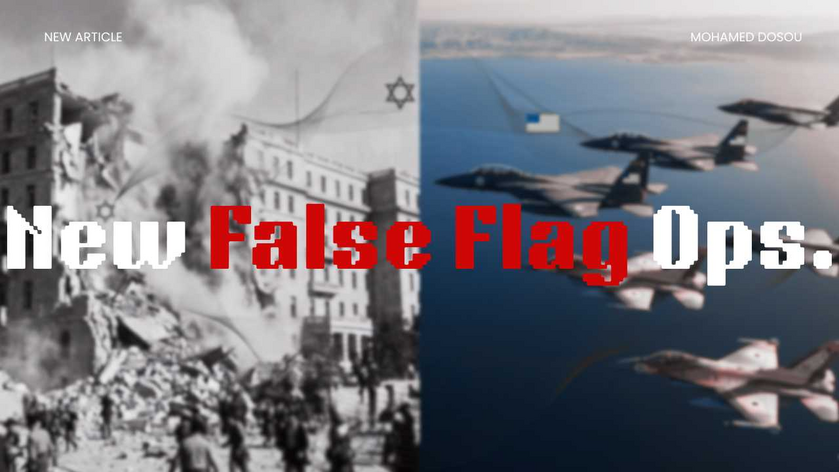
The hotel lobby was a swirl of khaki and linen, the clink of glasses barely masking the hum of colonial administration. It was July 22, 1946, at Jerusalem’s King David Hotel. The southern wing housed the nerve center of the British Mandate - the secretariat and military command of an empire that seemed as permanent as the ancient stones upon which the city was built. Within minutes, a thunderous explosion would tear through that wing, collapsing the façade and burying the illusion of British permanence under nine feet of rubble. The attack, carried out by the Irgun, a Zionist paramilitary group, was a pivotal act in a broader insurgent campaign of bombings, assassinations, and psychological warfare that would, within two years, convince a war-weary Britain to wash its hands of Palestine and withdraw entirely .

Fast forward eighty years. The year is 2026. The landscape is now the entire Middle East, and the superpower casting a long, weary shadow is not Britain, but the United States of America. And in the corridors of alternative media and geopolitical analysis, a provocative and deeply unsettling question is being asked: Is Israel, now a nuclear power, using the same brutal, asymmetrical playbook it once employed as an insurgent force to engineer the expulsion of its primary patron?

The thesis, as explosive as the milk churns filled with TNT that brought down the King David Hotel, posits that Israel is deliberately orchestrating a high-stakes gambit. The goal is to force the United States into a direct, catastrophic war with Iran - not to win it cleanly, but to create such profound domestic political upheaval in America, such a visceral anti-war backlash, that the US is compelled to retreat from the entire Middle East. This would, in theory, leave Israel as the undisputed regional hegemon, free to pursue its strategic and settlement ambitions without the constraining hand of its most important ally.

This is not a theory that has found a home in the pages of Foreign Affairs or the briefings of the State Department. Yet, in March 2026, it exploded into the mainstream via the immense megaphone of Tucker Carlson.

On his online show, Carlson laid out a labyrinthine narrative that connected ancient prophecy, messianic Jewish groups, and realpolitik. He spoke of a “religious layer” to the current conflict, but not the one typically associated with Shia militancy or the Islamic Republic’s apocalyptic rhetoric. Instead, he pointed toward Jerusalem. “The holiest spot on earth…called the foundation stone,” Carlson said, explaining its significance in Judaism. Without the ability to worship and sacrifice there, he argued, “you can’t really have Torah Judaism.” He then made his explosive claim: that influential elements within Israel, including some associated with the Chabad Hasidic movement, are pushing for the destruction of the Al-Aqsa Mosque and the Dome of the Rock to facilitate the rebuilding of the Third Temple . The ensuing global Islamic outrage, Carlson suggests, would be blamed on Iran, serving as the ultimate false flag to drag America into a war of civilizations .

Carlson’s presentation was immediately and fiercely condemned. The Jerusalem Post published a scathing op-ed, accusing him of descending into “dark conspiracy thinking” and launching an “anti-Israel crusade.” It dismissed his arguments as “mumbled and jumbled, disoriented claptrap,” pointing out that official Israeli policy maintains the status quo on the Temple Mount and that mainstream Jewish teachings relegate the Temple’s rebuilding to a future messianic era of peace, not a modern political act of war . The Chabad-Lubavitch movement itself issued a statement calling Carlson’s claims “false and misleading,” emphasizing that the movement “does not advocate violence or political efforts to demolish the mosque” .

Yet, to dismiss the entire thesis simply because its most prominent proponent is a controversial figure would be to ignore the geopolitical currents that give such theories their power. Carlson’s narrative, however embellished, taps into a deep well of historical memory and strategic anxiety. The tactics he describes - the “false flag” operation, the provocation of an overwhelming response from a larger power, the manipulation of an ally’s domestic politics - are not new. They are the classic tools of the weak against the strong. They are, in essence, the tools the Irgun used against the British.

The parallels, for those who draw them, are uncanny. The British Empire in the 1940s was overstretched, financially exhausted by World War II, and facing growing domestic opposition to its imperial commitments. Sound familiar? The United States in the 2020s finds itself in a remarkably similar position. After two decades of inconclusive wars in Iraq and Afghanistan, the American public is deeply isolationist. A March 2026 poll by Reuters/Ipsos found that a staggering 56% of Americans believe President Donald Trump is too quick to use military force, a sentiment shared even by a quarter of his own Republican base . The US military, despite its unparalleled budget, is logistically overstretched, trying to maintain deterrence in the Pacific against China, manage a foothold in Europe, and respond to crises in the Middle East simultaneously .

It is into this picture of imperial exhaustion that the historical analogy is projected. The Irgun and its ideological kin, the Lehi (or Stern Gang), understood the psychology of the weary empire. Their campaign was not designed to defeat the British Army in the field - a military impossibility. It was designed to make the cost of staying in Palestine unbearably high, both in blood and in treasure, and, crucially, in the currency of domestic political will. The bombing of the King David Hotel, which killed 91 people, was a masterstroke of asymmetric warfare. It was an attack on the very symbol of British administrative power, broadcast around the world, and it shattered the perception of British control.

The modern analogy, in this telling, is not a single bombing but a cascade of provocations aimed at dragging Iran into a war with the US. The strategy, as theorists and some analysts describe it, is for Israel to act as the insurgent, striking at US interests or those of its Gulf allies, and ensuring the blame falls on Tehran. The desired result is an overwhelming American military response - a response that would mire the US in another Middle Eastern quagmire, this time against a far more formidable foe than the Taliban or Saddam Hussein’s depleted army.

The ultimate prize, in this Machiavellian calculus, is not victory over Iran per se, but the process of the war itself. A bloody, protracted, and costly ground invasion of Iran would be the modern-day equivalent of the King David Hotel bombing - a shock so profound that it would shatter the American public’s already fragile tolerance for foreign entanglements. The sight of American body bags returning from the Zagros Mountains would be the image that finally turns the United States inward for good.

This would pave the way for what some strategic analysts see as the logical conclusion of the “America First” doctrine: a full-scale strategic retrenchment. The Trump administration’s newly released National Security Strategy already signals a major pivot away from the Middle East and Europe, declaring that “restoring US pre-eminence in the Western Hemisphere is now Washington’s most important foreign-policy objective” . The strategy speaks of uniting the Americas as a single geopolitical unit and securing the homeland from migration and drugs. It implicitly downgrades priorities in East Asia and the Middle East .

This formal strategic document, written before the latest escalation with Iran, provides the essential backdrop. It confirms that the US is already looking for a way out. An analyst from the International Institute for Strategic Studies (IISS) noted the core tension: “the revived emphasis on hemispheric primacy sits uneasily with Washington’s enduring operational commitment to forcing outcomes in other theatres” . Israel, the theory suggests, is merely accelerating this inevitable departure on its own terms - by slamming the door shut with such force that it destroys the hinges, ensuring that America can never come back.

But is this a cunning strategy or a paranoid fantasy? The difference often lies in the eye of the beholder, and in the next part, we will examine the mechanics of the trap as it is perceived to be closing around the United States, from the oil fields of Saudi Arabia to the volatile hilltops of the West Bank.

The Mechanics of the Trap - False Flags and Fiery Frontiers

Amidst the fog of a hot war with Iran, allegations of “false flag” operations surface, suggesting a deliberate campaign to immolate the Gulf states and chain the US military to Israel’s defense, leaving American forces overstretched and vulnerable.

By early March 2026, the fog of war that had descended over the Middle East was thick enough to obscure not just troop movements, but reality itself. The coordinated American-Israeli assault on Iran, which began on February 28, was well underway . US Central Command reported casualties - six American service members killed in the initial days, a number that would tragically climb . The fighting was no longer confined to the Persian Gulf; it had metastasized. Iran was striking at a “dozen or so countries,” widening the conflict into a truly regional conflagration . And within this chaos, a secondary battle erupted: a battle over the narrative of who was really striking whom.

On March 2, a dramatic twist emerged from Tehran. An Iranian military official made a stunning allegation: the drone attack on Saudi Arabia’s massive Ras Tanura oil refinery - a facility critical to global energy supplies - was not the work of Iranian proxies. Instead, the official claimed it was an Israeli “false flag operation,” a piece of black-ops theater designed to blame Iran and further inflame the situation .

The logic, from Tehran’s perspective, was impeccable. The attack on the Aramco facility served to galvanize Gulf Arab states against Iran, pushing them closer to the US-Israel axis. If Israel could bomb a Saudi oil facility and make it look like it came from Iran, it would achieve two critical objectives: it would eliminate any hope of Saudi-Iranian détente, and it would make the Gulf monarchies actively beg for American military protection, further entrenching the US presence in the conflict.

This allegation was quickly followed by another, even more explosive, claim. Tucker Carlson, building on his Temple Mount narrative, reported that his sources indicated Saudi Arabia and Qatar had actually arrested cells of Mossad agents who were planning bomb attacks within the Gulf nations themselves . The implication was staggering: that Israel’s spy agency was actively working to destabilize the very countries that were its tacit allies against Iran, all to ensure the war continued on Israel’s preferred trajectory.

These reports, emerging from the fever swamp of wartime information, were impossible to verify. The Times of India, reporting on the claims, presented them as part of the “new twist” in the conflict, a twist defined by dueling narratives and allegations of dark deceit . But whether true or not, their very existence altered the political landscape. For a US public already deeply skeptical of the war, the suggestion that their “ally” was manipulating events to trap them further was political poison.

The core of the “trap” thesis, as articulated by figures like Tucker Carlson and even some conservative writers, rests on this idea of entrapment - or, in a more evocative term used by the Heritage Institute’s John Daniel Davidson, being “chain-ganged” . In a piece published just days before the strikes on Iran began, Davidson argued that “Israel appears to have succeeded in such entrapment, forcing the Trump administration into a war not necessarily of its choosing or timing” . The imagery is powerful: the US, like a reluctant gunfighter, is dragged into a showdown by a more eager partner who has slipped the chains around its neck.

The mechanics of this entrapment, according to this view, are not reliant solely on dramatic false flags like the bombing of mosques or oil facilities. They are also structural. They are built into the very architecture of the US military’s global posture. As the Trump administration surged assets to the Middle East to counter Iran, it simultaneously redeployed significant resources - including a carrier strike group - to the Caribbean for operations in Venezuela . This created a strategic gap. The US military, despite its $1.5 trillion proposed budget, found itself in the position of a fire department with too many fires and not enough engines. As one analysis put it, “the United States lacks the military capacity to conduct overt and ongoing military operations at scale in every theater of the globe” .

This overstretch is the trap’s jaw. By forcing the US to concentrate its assets in the Middle East to defend Israel and strike Iran, the theory posits that Israel is deliberately weakening America’s posture elsewhere - most critically, in the Pacific, where China watches and waits. A carrier strike group redeploying from East Asia to the Gulf “only creates a new and worse strategic gap in the name of adventurism well outside of true U.S. interests,” the analysis continued .

But the trap is not just about moving ships. It’s about draining blood. The most potent political weapon in this asymmetric war is the American soldier. The IISS analysis presciently noted that the US commitment to forcing outcomes in the Middle East sits uneasily with its new hemispheric priorities . This unease translates directly into political risk for the commander-in-chief.

By early March, the human cost was already being tallied. Six dead. Then thirteen. Each name, each hometown, each flag-draped coffin became a data point in a political equation . A Reuters/Ipsos poll conducted as the news of casualties spread found a critical fault line within the Republican party. While 55% of Republicans supported the strikes on Iran, that support was deeply conditional. The poll revealed that 42% of Republicans said they would be less likely to support the action if it led to “US Middle East troop deaths” . The deaths were no longer hypothetical. They were real. And the political fallout had begun.

This is the heart of the alleged Israeli gambit. It is not about defeating Iran’s military. It is about defeating the US’s will to remain in the region by forcing it to fight a war on Israel’s terms - a war that is costly, indecisive, and deeply unpopular. By striking at US interests, real or perceived, and ensuring a spiral of escalation, Israel can force America’s hand. It can compel the US to strip other theaters of defense assets and pour them into the Gulf. It can force the US to put “boots on the ground” to protect its bases, its allies, and its reputation.

And then, the ultimate provocation: the false flag so enormous that it would shatter any remaining hope of diplomacy. Carlson’s focus on the Temple Mount is not arbitrary. He understands its power. “Right now, like this week, is the moment that some people…would like to begin the process of tearing down the Dome of the Rock, tearing down Al-Aqsa Mosque and rebuilding the Third Temple,” he claimed . An attack on the third-holiest site in Islam, blamed on Iran, would be a 9/11-scale event for the Muslim world. It would make the Iraq War look like a skirmish.

In this terrifying scenario, the US would have no choice. It would be forced to launch a full-scale invasion of Iran, not out of strategic choice, but out of an obligation to avenge an act of sacrilege perpetrated, in this telling, by the very ally it was defending. The “chain-gang” would have reached its destination: a ground war in the most difficult terrain on earth, against a nation of 85 million people, with the entire Muslim world watching.

And as the first American Marines waded ashore, or parachuted into the Iranian plateau, the trap would snap shut, not just on the US military, but on the political future of Donald Trump and the Republican Party.

The Domestic Front - Blood, Ballots, and the Breaking of Will

As American casualties mount and gas prices soar, the political ground shifts beneath President Trump. With midterm elections looming, the “Israel’s war” narrative threatens to fracture his coalition and ignite a domestic firestorm that could redefine American globalism.

In the cold, calculating calculus of geopolitics, it is easy to forget that wars are not fought by abstractions like “hegemony” or “strategic depth.” They are fought by sons and daughters, and they are paid for by families at kitchen tables struggling with the price of a gallon of milk and a tank of gas. It is in this visceral, human space that the political fate of presidents is decided. And it is here, in the hearts and wallets of the American electorate, that the alleged Israeli strategy finds its most fertile ground.

By the second week of March 2026, the human and economic costs of the US-Israeli campaign against Iran were no longer theoretical. They were starkly, painfully real. The headlines told a story of escalation: “6 US soldiers killed” . The number would soon climb to 13, each name a private tragedy with public consequences . The financial news was equally grim. Brent crude futures spiked 10%, hurtling toward $80 a barrel, with analysts predicting a climb to $100 . For millions of Americans living paycheck to paycheck, the war had arrived not as a call to patriotism, but as an unwelcome visitor at the gas station and the grocery store.

The political impact was immediate and devastating for the Trump administration. Polling conducted by Reuters/Ipsos in the wake of the strikes showed the president’s approval rating dipping to 39% . But the more dangerous numbers were hidden in the cross-tabs. A CNN poll found that a staggering 59% of Americans opposed the military action against Iran . This wasn’t just the “usual suspect” opposition from the Democratic base. It was a broad, cross-cutting sentiment rooted in deep war-weariness and economic anxiety.

The data painted a portrait of a nation that had lost its taste for foreign adventures. The poll found that 60% of Americans believed Trump had no clear plan for dealing with Iran, and 62% thought he should be required to get congressional approval for any further military moves . This wasn’t just partisan sniping; it was a constitutional crisis in waiting. The administration was conducting a war without a clear mandate, and the public was beginning to notice.

Most ominously for a president facing a crucial midterm election, the economic pain was directly linked to support for the war. The Reuters/Ipsos poll found that 45% of respondents - including 34% of Republicans and 44% of independents - said that rising gas prices would make them less likely to support the military action . The anti-war vote was no longer confined to college campuses and left-wing blogs. It was forming in the checkout lines of suburban Walmarts.

This is the political trap that the theorists claim Israel has set. It is not a trap of military defeat, but of political self-immolation. By forcing the US to lead a war against Iran, Israel has handed a political weapon to every opponent of Donald Trump. The narrative began to crystallize in the media, articulated most bluntly by commentator Megyn Kelly. “The US service members who were killed by the Iranian drone died for Iran or for Israel,” she declared. “This is clearly Israel’s war. Our government’s job is not to look out for Iran or Israel” .

The phrase “Israel’s war” became the meme that could sink a presidency. It frames the conflict not as a battle for American security, but as a proxy war fought with American blood and treasure for the benefit of a foreign power. This is an incredibly potent political attack, especially in an era of heightened isolationism. It taps into a deep American suspicion of being used, of being the “sucker” who pays the price while others reap the rewards.

Within the Republican party, the strain began to show. While a majority of Republicans initially supported the strikes, the coalition was fracturing. The 42% of Republicans who said US casualties would make them reconsider their support represented a potentially fatal crack in the base . The party of Reagan, the party of muscular internationalism, was now deeply divided between a leadership class still committed to the alliance with Israel and a populist base that wanted to “come home.”

Enter Tucker Carlson, stage left. For years, Carlson has been the tribune of this populist, anti-interventionist wing of the Right. His relentless focus on the “Israel’s war” narrative is not just a bid for ratings; it is a political project aimed at realigning the American Right along nationalist, non-interventionist lines. His March 2026 monologues, weaving together tales of Chabad conspirators and Temple Mount plots, were the intellectual (or anti-intellectual) fuel for this fire . He was giving his audience permission to be suspicious of Israel, to question the alliance, to see the war not as a noble cause but as a con game.

The reaction from pro-Israel forces and the administration was swift. They called “bullsh*t” . Axios reporter Marc Caputo, citing top administration officials, flatly denied Carlson’s claims that he was being investigated by the CIA, framing the commentator as a useful, but unwitting, tool spreading disinformation that just so happened to align with the adversary’s narrative . But the denial did little to stop the spread of the idea. Once “Israel’s war” entered the political lexicon, it became a self-replicating meme, immune to fact-checks.

This domestic firestorm has a deadline: the November 2026 midterm elections. These elections will determine whether Republicans maintain their narrow control of Congress. The strikes on Iran began just days before the midterm primaries . The timing could not have been worse for Trump. Historically, the president’s party loses seats in midterms. An unpopular, costly war with no end in sight is the kind of “October Surprise” (or in this case, “March Surprise”) that can flip entire chambers.

If the Democrats were to retake the House or the Senate, Trump’s political agenda would grind to a halt. More importantly, a Democratic Congress would almost certainly launch investigations into the lead-up to the war. They would subpoena emails, call witnesses, and probe the back-channel communications between the Netanyahu government and the Trump White House. The “collusion” narrative of 2026 would not be about Russia, but about Israel. It would be a political circus of epic proportions.

And what if the public’s anger boils over? The poll numbers hint at a deeper rage. A quarter of Americans said that the prospect of putting “boots on the ground” in Iran would make them “much less supportive” of the war . If the conflict escalates to a ground invasion, as some fear, and the body bags start coming home in the hundreds, the political pressure could become irresistible. It could lead to a full-blown constitutional crisis.

The most extreme scenario, whispered in the darker corners of the internet and picked up by Carlson, is that Trump could face impeachment - or worse, that the political system could buckle under the strain . While this seems far-fetched, the underlying dynamic is real. A president leading an unpopular war, facing a hostile Congress, and confronting a public that believes they were lied into the conflict is a president in existential political danger.

From this maelstrom of domestic discontent, a new strategic horizon begins to emerge for America - one that has very little to do with the Middle East and everything to do with the shores of the Caribbean and the icy expanse of Greenland.

The New World Disorder - America’s Retreat and Israel’s Dominion

As the US pivots to the Americas, seizing assets and sealing borders, the Middle East is left to a new reality. With its superpower patron gone, Israel stands alone, unshackled, ready to redraw the map from the river to the sea - and beyond.

The bombs are still falling on Iran. American soldiers are still dying in a faraway land. But in the corridors of power in Washington, a different map is being unrolled. It is a map of the Western Hemisphere, and on it, the future of American grand strategy is being drawn in bold, uncompromising lines. The war with Iran, whatever its outcome, may be the last gasp of an old America - the global policeman - while the real action is shifting to a new America: the hemispheric sheriff.

The official doctrine is already in place. The National Security Strategy released in December 2025 is clear: “Restoring US pre-eminence in the Western Hemisphere is now Washington’s most important foreign-policy objective” . This is not a temporary tilt; analysts from the IISS and China-US Focus describe it as a “major shift,” a “true return to isolationism and nationalism” that represents a medium- to long-term trajectory for the country .

The logic is brutally pragmatic. The post-Cold War era of liberal globalism is dead. It died in the sands of Iraq and Afghanistan, and it was buried by the 2008 financial crisis, which laid bare the hollowing out of the American middle class. As one analysis put it, “The unchecked growth of capital globalization has widened the wealth gap, with the rich reaping most of the benefits. The broad middle and lower classes have lost out” . The resulting political force, “America First,” is now the establishment.

This new strategic doctrine, however, is not passive. It is an aggressive, expansionist isolationism. It seeks to secure the homeland by dominating its immediate neighbors. The Trump administration has already demonstrated its willingness to use force in the region, launching strikes on Venezuela and threatening action against Mexico, Cuba, and Colombia . It seized Venezuelan President Nicolas Maduro . It has talked openly of purchasing Greenland, a territorial ambition that, while quixotic, signals a desire to extend US power deep into the Arctic .

This is the future: a United States that is drawing a protective bubble around the Americas, using whatever means necessary - military, economic, diplomatic - to control migration, secure resources, and eliminate perceived threats. It is a fortress America, with the drawbridge pulled up and the moat patrolled by carrier strike groups that used to be stationed in Japan or the Persian Gulf .

The implications for the Middle East are profound and, for the states there, terrifying. If the US is serious about this pivot, it means the gradual, or not-so-gradual, abandonment of its traditional allies. The strategic analyst community is already warning of this risk. “The administration’s clear agenda…is to frame its hemispheric vocation” in a way that “implicitly downgrades related US priorities in East Asia, the Middle East and Europe” . The US is choosing its neighborhood over the world.

This is the point at which the theory and strategic reality converge. The theory posits that Israel wants the US to leave, to create a vacuum it can fill. The reality is that the US wants to leave, to tend to its own garden. The convergence of these two desires creates the perfect storm.

If the US were to accelerate its retreat from the Middle East - perhaps triggered by a political implosion over the Iran War - it would leave Israel in a position of unchallenged, but also unsupported, dominance. The Gulf Arab states, who have spent decades building their defense architecture around the American security guarantee, would be left exposed. The US bases in Qatar, Bahrain, and the UAE, built at a cost of billions and over decades, would become either irrelevant or vulnerable. The theory suggests Israel is willing to see these “Gulf states get hurt,” to see their infrastructure damaged, because it serves the larger purpose of clearing the field .

In this new, post-American Middle East, Israel would be the only nuclear power, the most advanced military, and the most aggressive actor. Unconstrained by a US administration that often counsels restraint (however futilely), Israel would be free to pursue its maximalist goals. This includes the expansion of settlements in the West Bank, the eventual annexation of territory, and the management of the Palestinian population through force. It could mean a more permanent military solution to the threat from Hezbollah in Lebanon and from Iran’s remaining proxies. The dream of a “Greater Israel,” from the river to the sea, would no longer be a revisionist fantasy but a potential policy platform.

This is the vision that alarms not just the Arab world, but also many American strategists who see the US retreat as a betrayal of allies and a gift to rivals like China and Russia. Yet, the domestic political momentum is almost impossible to stop. The American public is tired. As the China-US Focus analysis noted, “The United States is finding it increasingly challenging to sustain its global hegemony” . The country is suffering from “hegemonic decline,” marked by dysfunctional institutions and a populace that no longer believes in the mission.

For Israel, this creates an extraordinary opportunity, but also an existential danger. The opportunity is to reshape the region in its own image. The danger is that without the US as a buffer and a deterrent, Israel’s enemies may eventually coalesce into an even more formidable alliance. Iran, battered but not broken by the 2026 war, would harbor a generations-long grudge. The Arab street, inflamed by the destruction of Al-Aqsa, could topple the remaining pro-Western monarchies, replacing them with Islamist governments.

Yet, the proponents of the “trap” theory believe Israel is willing to take that risk. They believe that figures like Netanyahu and the messianic right see this moment as a divinely ordained opportunity. The rebuilding of the Third Temple, the ingathering of the exiles, the defeat of modern-day Amalek - these are not just political goals; for some, they are religious imperatives. Carlson’s fixation on the “religious layer” resonates because, for a small but powerful group of Jewish and Christian Zionists, the end-times are now. The chaos, the war, the suffering - it is all part of the plan.

As the United States turns its gaze from the deserts of the Middle East to the shores of Greenland and the oil fields of Venezuela, it leaves behind a region in flames. The question of whether Israel deliberately lit those flames to force the American departure may never be definitively answered. The official record, if it ever sees the light of day, will be redacted and contested. The truth, as always, will be the first casualty.

But what is undeniable is the trajectory. The American empire is contracting. Its citizens are exhausted. Its politicians are afraid. And into that void of power and will, other forces rush. Whether Israel is the puppet master or merely the primary beneficiary of these historical currents, the result is the same: a Middle East left to its own devices, dominated by a single, powerful, and ideologically driven state, free at last from the constraints of its most important friend. The lessons of the King David Hotel have been learned, perfected, and applied on a continental scale. The empire struck back, not by staying, but by finally, irrevocably, going home.

Read full Article
post photo preview
The Theater of Power
Trump, Spectacle Politics, and the Fragile Future of American Democracy

I. The Year That Began Without Gravity

There are years that arrive quietly, easing societies into continuity. And then there are years that feel immediately unmoored, as though the stabilizing forces that once held institutions in place have suddenly weakened. The opening weeks of 2025 belong firmly to the latter category.

What distinguishes this moment is not the emergence of crisis alone, but the speed with which accumulated pressures appear to have lost containment. Political language has grown sharper, executive power more theatrical, and the distance between constitutional norms and rhetorical experimentation alarmingly thin. Events that once would have provoked national reckoning now arrive in clusters, barely processed before being replaced by the next provocation.

The sensation is not unlike watching a carefully balanced structure collapse piece by piece - not because of a single decisive blow, but because too many load-bearing norms have been removed without concern for consequence.

At the center of this destabilization stands the figure of President Donald Trump, whose governing style has never aspired to institutional quietude. Yet what now emerges is something more severe than mere disruption. It is a governing philosophy rooted in escalation, personalization, and spectacle - one that treats democratic systems not as constraints to respect, but as props to manipulate.

II. Governance as Escalation, Not Resolution

Traditional democratic leadership is measured, at least in part, by its capacity to absorb conflict without amplifying it. The ability to de-escalate unrest, to distinguish between dissent and disorder, and to preserve legitimacy even amid disagreement has long been understood as the core responsibility of executive power.

The governing posture that has increasingly defined Trump’s presidency in 2025 moves in the opposite direction.

When federal enforcement actions provoke public unrest, the response is not reconciliation but threat. When protests erupt, the rhetoric does not seek understanding but casts suspicion. Disorder is not treated as a social signal demanding political repair, but as justification for coercive force.

This logic is circular and self-reinforcing. Federal actions generate resistance. Resistance is framed as criminality or conspiracy. Criminality becomes the rationale for militarization. Militarization, in turn, deepens alienation, ensuring further unrest.

In this framework, governance becomes indistinguishable from confrontation. The president does not act as mediator between state power and civil society, but as antagonist to a public increasingly portrayed as hostile, manipulated, or illegitimate.

III. The Suspicion of Civic Motive

One of the most revealing elements of this political worldview is its profound mistrust of ordinary civic motivation.

Public protest, in this telling, cannot arise organically. Dissent must be purchased. Conviction must be compensated. Conscience, unless monetized, does not exist.

This assumption reveals more about the psychology of power than about the protesters themselves. It reflects a deeply transactional understanding of human behavior - one in which loyalty is bought, outrage is staged, and belief is always a performance for pay.

The implications are corrosive. If protest is never sincere, then persuasion is unnecessary. If dissent is always foreign-funded or professionally orchestrated, then repression becomes justified. And if the public is imagined not as a political community but as a manipulated crowd, then democratic accountability dissolves.

In such a worldview, the state owes its citizens nothing beyond order. Participation becomes suspect. Opposition becomes treasonous.

IV. Militarization as Domestic Theater

The invocation of federal troops in response to civil unrest marks a dangerous symbolic threshold - not because such authority does not legally exist, but because of how casually it is now introduced into political discourse.

Military force, when directed inward, carries a weight that exceeds its tactical function. It communicates a shift in the state’s self-perception: from guarantor of civil peace to enforcer of political compliance.

The normalization of this language matters. Even when troops are not deployed, the threat itself reshapes expectations. It conditions the public to accept the presence of armed force in civic life. It reframes protest not as participation, but as insurrection.

Once this framing takes hold, emergency powers become easier to justify. The distinction between civilian governance and martial authority blurs. And the space for peaceful dissent narrows.

V. The Authoritarian Joke Problem

Perhaps the most unsettling feature of the current political moment is the ambiguity surrounding presidential speech.

Statements about suspending elections, eliminating democratic processes, or extending executive rule are often dismissed as jokes, exaggerations, or provocations meant to unsettle opponents. Yet humor functions differently when it comes from power.

Authoritarianism rarely announces itself solemnly. Historically, it advances through suggestion, normalization, and the gradual erosion of taboo. What begins as jest becomes possibility. What is laughed off one year is tested the next.

The danger lies not in any single statement, but in the cumulative effect of repetition. When democratic norms are repeatedly mocked, their moral authority weakens. When elections are treated as optional, their inevitability fades. And when the public is asked to guess whether a leader is joking or serious, the uncertainty itself becomes destabilizing.

Democracy depends on predictability. Ambiguity, when wielded by power, is not humor - it is leverage.

VI. Demonization and the Language of Dehumanization

A defining feature of authoritarian political trajectories is the transformation of political opposition into existential threat.

The language employed to describe opponents - “vermin,” “enemies,” “traitors,” “invaders” - is not incidental. It is preparatory. Such rhetoric reframes disagreement as pathology, and difference as danger.

Once opponents are cast as subhuman or alien, extraordinary measures become thinkable. Legal protections appear indulgent. Violence becomes defensive.

This is not merely rhetorical excess. It is the moral groundwork of repression.

VII. Emergency Powers and the Illusion of Order

The consolidation of executive authority often proceeds under the banner of necessity.

Crisis becomes opportunity. Disorder becomes pretext. The promise of restored order is offered in exchange for suspended norms.

Yet emergency powers, once invoked, rarely retreat fully. They leave institutional residue. Precedents linger. The extraordinary becomes ordinary.

What is lost is not only legal balance, but civic expectation. Citizens acclimate to rule by decree. Accountability weakens. Governance becomes episodic, driven by spectacle rather than deliberation.

VIII. Policy as Branding: The Hollow Center of Performance

Nowhere is the theatrical nature of this governance style clearer than in the realm of policy.

Grandly named initiatives appear without substance, coherence, or feasibility. Mathematical impossibilities are asserted with confidence. Structural complexity is replaced by slogans.

Policy becomes marketing. Governance becomes branding.

This hollowing out matters. When citizens are offered fantasy instead of function, trust collapses. The state ceases to be an instrument of collective problem-solving and becomes a stage for personal mythmaking.

IX. Vanity as Foreign Policy

The personalization of power extends beyond domestic governance into diplomacy itself.

International engagement is filtered through ego, recognition, and symbolic reward. Prestige substitutes for principle. Flattery becomes currency.

In this environment, serious statecraft is reduced to transactional theater. The global order is navigated not through strategy, but through affirmation.

Such personalization introduces profound instability. Alliances become conditional. Commitments fluctuate with mood. Diplomacy loses continuity.

X. The Infantilization of Power

Underlying much of this political style is a troubling immaturity - not in temperament alone, but in institutional understanding.

Power is treated as entitlement rather than responsibility. Constraint is resented rather than respected. Complexity is dismissed as weakness.

This infantilization is dangerous precisely because it coincides with unprecedented destructive capacity. Modern executive authority controls forces that can devastate societies, economies, and ecosystems. When such power is wielded impulsively, the margin for error disappears.

XI. Historical Warnings Ignored

History offers no shortage of warnings about leaders who confuse spectacle with strength.

Democracies do not usually collapse through coups alone. They erode through normalization - when citizens grow accustomed to rhetoric that would once have shocked, when institutions bend rather than resist, when legality is treated as technicality rather than principle.

The tragedy is not ignorance of history, but indifference to it.

XII. Democracy as a Moral Practice

Democracy is not merely a system of elections. It is a moral discipline - a collective agreement to resolve conflict without annihilation, to accept limits even when inconvenient, and to treat opponents as legitimate participants rather than enemies.

When leadership abandons this discipline, democracy does not vanish overnight. It thins. It hollows. It becomes procedural without substance.

XIII. The Danger of Normalization

Perhaps the gravest risk of the current moment is habituation.

Citizens adjust. Media adapts. Institutions accommodate. What once felt alarming becomes background noise.

This is how erosion succeeds - not through shock, but through fatigue.

XIV. A Choice Still Open

Despite the severity of these trends, history is not finished.

Democratic decline is not destiny. Institutions can recover. Norms can be reasserted. Power can be restrained.

But only if societies refuse to mistake spectacle for leadership, coercion for strength, and dominance for legitimacy.

The future of American democracy will not be decided by a single election, policy, or personality. It will be decided by whether citizens insist that power serve the public rather than perform for itself.

In the end, democracy does not fail when leaders overreach alone. It fails when restraint is no longer demanded.

Read full Article
post photo preview
The Collapse of Global Restraint
Power Politics, Moral Failure, and the Return of Existential War

I. A World Losing Its Nerve

There are moments in history when catastrophe announces itself not through sudden violence, but through language. Before bombs fall, before borders burn, societies reveal their trajectory in the words their leaders choose - and in the ideas their publics are taught to accept as normal.

We are living through such a moment.

What defines the current geopolitical era is not merely the accumulation of crises, but the evaporation of restraint. Strategic caution, legal norms, and moral taboos - painfully constructed after the ruins of the twentieth century - are no longer treated as guardrails. They are increasingly framed as obstacles. What once required secrecy is now discussed openly. What once demanded justification is now assumed. What once provoked horror is now debated as policy.

This is not a story about a single war, a single country, or a single ideology. It is the story of a system losing its memory.

The post–World War II order was built on a shared recognition: that modern industrial war, especially between great powers, is not survivable. That assassination as statecraft corrodes legitimacy. That borders altered by force invite endless retaliation. That nuclear weapons exist not to be used, but to terrify humanity into restraint.

Today, those principles are no longer sacrosanct. They are negotiable.

II. Multiplying Crises, Shrinking Judgment

The contemporary world presents a constellation of flashpoints that would, in any earlier era, have demanded extreme caution.

The possibility of direct confrontation between the United States and Iran threatens to destabilize one of the most strategically sensitive regions on earth. Iran is not Iraq. It is not Libya. It is a civilizational state with deep social cohesion, vast energy reserves, and regional alliances capable of retaliatory escalation. Any serious conflict risks collapsing regional stability, disrupting global energy markets, and triggering mass displacement on a scale unseen in decades.

At the same time, casual discussions of territorial acquisition - such as the absorption of Greenland - signal something equally corrosive: the erosion of the principle that borders are inviolable. This principle was not moral idealism; it was pragmatic survival. Once power alone determines ownership, alliances become meaningless, and smaller states exist only at the mercy of stronger ones.

Elsewhere, regime change is increasingly framed not as a tragic last resort, but as a routine instrument. The removal or coercive capture of foreign leadership - often justified through legal abstractions - has produced not stability, but chaos: power vacuums, criminalized economies, and generational trauma.

Yet all of these dangers, grave as they are, function as prelude rather than climax.

The true epicenter of systemic risk lies in Eastern Europe.

III. The Proxy War That Refuses Its Name

The war in Ukraine is often described as a localized conflict, a defensive struggle, or a moral crusade. These descriptions obscure more than they illuminate.

In reality, this conflict has long since transcended Ukrainian sovereignty. It is a proxy war between nuclear-armed powers, conducted on Ukrainian soil, financed and guided by external actors, and justified through narratives that rarely account for Ukrainian human cost.

This does not absolve Russia of responsibility for its actions. It does not sanctify military invasion. But moral clarity demands honesty: this war did not emerge in a vacuum, nor is it sustained by Ukrainian agency alone.

What makes the present moment uniquely dangerous is not the continuation of the war, but the language surrounding its “resolution.”

IV. When Assassination Becomes Acceptable Speech

Perhaps the most alarming development in Western political discourse is the casual endorsement of assassination as a legitimate policy tool.

Calls for the removal by death of a sitting head of state are no longer confined to anonymous forums or extremist rhetoric. They are articulated openly by elected officials, commentators, and strategists, often to applause rather than condemnation.

This represents a profound moral rupture.

Extrajudicial killing was once universally recognized as destabilizing and illegitimate. Its normalization erodes the very foundation of international law. If political murder becomes acceptable when justified by moral outrage, then no leader, anywhere, is secure. Diplomacy collapses into perpetual covert warfare. Deterrence transforms into paranoia.

Equally troubling is the intellectual laziness underlying this rhetoric. It rests on a fantasy: that complex political systems collapse neatly when one man is removed. History offers no support for this belief. States are not run by individuals alone, but by networks - military institutions, economic interests, intelligence agencies, ideological factions.

Assassination does not end conflicts. It multiplies them.

V. The Illusion of Moral Superiority

Western political culture increasingly frames itself as morally exceptional - uniquely entitled to define good and evil, legality and criminality. This self-image, once grounded in real achievements, has hardened into dogma.

It permits actions abroad that would be condemned instantly if directed inward. It justifies collective punishment through sanctions that devastate civilian populations while leaving power structures intact. It encourages narratives that dehumanize entire societies as backward, irrational, or inherently aggressive.

This moral asymmetry is not strength. It is decay.

A system that claims universal values but applies them selectively loses credibility. A political culture that equates disagreement with villainy forfeits diplomacy. A civilization that believes itself incapable of wrongdoing becomes incapable of correction.

VI. Europe’s Crisis of Meaning

One of the most striking dimensions of the current geopolitical landscape is Europe’s existential uncertainty.

Europe is not collapsing materially alone; it is unraveling psychologically. Its postwar identity - rooted in economic prosperity, American security guarantees, and moral rehabilitation - has reached its limits. Economic stagnation, demographic anxiety, and political fragmentation have eroded confidence in the future.

In this context, confrontation becomes seductive. External enemies offer internal coherence. War promises relevance. Moral crusades compensate for domestic failure.

Yet Europe’s history should inspire humility, not bravado. The continent that produced colonialism, racial hierarchy, and two world wars cannot afford amnesia. Power without self-knowledge is not leadership - it is repetition.

VII. Nuclear Weapons and the Restoration of Fear

The most chilling element of contemporary discourse is the renewed openness surrounding nuclear escalation.

Nuclear weapons were designed to instill terror - not in enemies alone, but in their possessors. Their moral function was restraint through fear. When that fear erodes, catastrophe follows.

The suggestion that nuclear use could be “limited,” “manageable,” or morally instrumental reflects a profound misunderstanding of both physics and psychology. Nuclear weapons do not escalate proportionally. They redefine reality.

Once the threshold is crossed, control becomes illusion.

To speak of nuclear war as strategy rather than tragedy is to confess civilizational exhaustion.

VIII. Civilization, Identity, and the Search for Meaning

At its deepest level, the present crisis is not geopolitical alone. It is spiritual.

Modern politics increasingly denies transcendence, tradition, and moral continuity. It reduces human beings to economic units, identities to abstractions, and history to inconvenience. In doing so, it erodes the instinct for self-preservation.

Civilizations survive not because they are powerful, but because they believe life is sacred, the future is real, and limits matter.

When those beliefs vanish, destruction becomes negotiable.

IX. Toward a Multipolar Reality

The emerging global order is no longer unipolar. Power is dispersing - not always toward justice, but toward balance.

This reality demands diplomacy, humility, and strategic maturity. It cannot be navigated through moral posturing or nostalgic dominance. Attempts to enforce a fading hierarchy through coercion will accelerate fragmentation, not restore control.

Multipolarity is not inherently dangerous. Recklessness is.

X. The Choice Before Us

History rarely announces itself as history. It whispers through normalized language, incremental decisions, and moral compromises justified as necessity.

We stand at a threshold not because war is inevitable, but because restraint is optional.

The future will not be decided by weapons alone, but by whether societies remember why those weapons were never meant to be used.

Civilizations do not collapse from weakness alone. They collapse when they forget why survival mattered.

The world does not need more certainty. It needs more humility.

And above all, it needs the courage to say that not everything that can be done should be done.

Read full Article
Available on mobile and TV devices
google store google store app store app store
google store google store app tv store app tv store amazon store amazon store roku store roku store
Powered by Locals